
Article: Why Choose a Lab Grown Diamond Ring
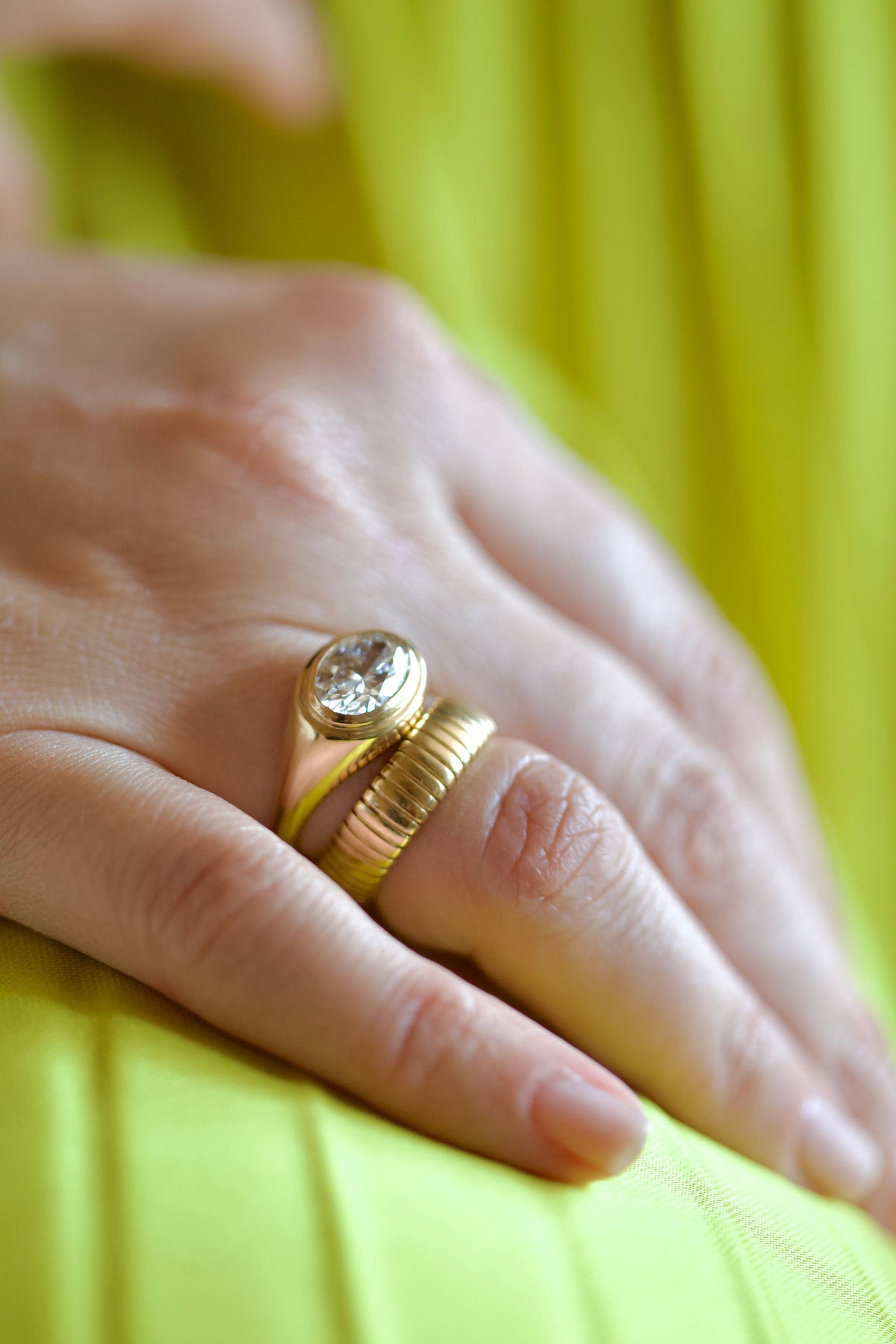
Why Choose a Lab Grown Diamond Ring
Many of us still wonder whether to choose a lab grown diamond or a natural diamond when shopping for a ring, whether it is for a special occasion like an engagement ring, or an everyday solid gold ring. Many considerations come to mind, from durability and cost to future resale value. In this blog I will give my take on lab grown diamond rings, the latest trends in lab grown diamond engagement rings, and some of my favorite everyday lab grown diamond rings.
What Are Lab Grown Diamonds?
Lab grown diamonds are real diamonds. They have essentially the same chemical, physical and optical properties as natural diamonds mined from the earth. The main difference is where they come from. Instead of forming deep beneath the earth over billions of years, lab grown diamonds are created in a controlled environment using technology that replicates the conditions needed for diamond growth.
The result is a genuine diamond, not a simulant such as cubic zirconia or a diamond imitation. It has the same hardness and can have the same brilliance, fire, and sparkle as a natural diamond. The difference is its origin: one was formed naturally within the earth, while the other was grown in a laboratory.
There are two methods to produce lab grown diamonds: HPHT and CVD.
HPHT — High Pressure High Temperature
This method mimics how natural diamonds form in the earth. A diamond seed is placed in a carbon-rich environment and subjected to extremely high pressure (1.5 million PSI) and temperature (around 1,500°C). Carbon crystallizes around the seed, gradually forming a diamond.
CVD — Chemical Vapor Deposition
A diamond seed is placed in a chamber filled with carbon-rich gases (usually methane). The gases are activated by microwave energy, causing carbon atoms to deposit onto the diamond seed, growing the crystal layer by layer. CVD is a different growth process from HPHT, and the resulting diamonds can have distinctive characteristics that allow gemological laboratories to identify the growth method.
Which is better?
Honestly, neither is objectively better — both produce real, certified diamonds that are chemically identical to mined diamonds. The more important question is the individual stone. Just like with a natural diamond, the quality of a lab grown diamond depends on its cut, color, clarity, proportions, and overall appearance. Two diamonds with exactly the same carat weight and grading can look very different in person.
However, in the industry CVD is currently more common because it is more scalable and cost-effective, while HPHT is sometimes preferred for producing very high color grades.
Cost Comparison: Lab Grown Diamond Ring vs. Natural Diamond Ring
Lab grown diamonds have changed the diamond market dramatically. According to The Knot's 2026 Real Weddings Study, lab grown center stones accounted for 61% of engagement ring purchases among the couples surveyed, up from 52% in 2024.
At the same time, lab grown diamond prices have continued to fall as production has scaled. Industry analyst Edahn Golan reported that wholesale lab grown diamond prices declined by an average of 26% in 2025, although the rate of decline slowed toward the end of the year.
Natural diamond prices have also declined in recent years. Rapaport's annual data shows significant price declines across many natural diamond categories, particularly in 2023 and 2024, although the amount varies considerably depending on carat weight, color, clarity, and shape.
To give you a better picture of current pricing, below is a cost comparison that I provided to a customer for a natural diamond ring vs. a lab grown diamond ring. This quote was made in April 2026 and reflects the prices I received from my diamond suppliers for an emerald-cut lab grown diamond in VVS or IF clarity and D–F color, compared with a natural diamond with the same general specifications.
| Carat weight | Lab grown diamond ring | Natural diamond ring |
|---|---|---|
| 1ct | $1,100 | $5,500 |
| 1.5ct | $1,350 | $10,500 |
| 2ct | $1,850 | $26,000 |
These are my supplier quotes from April 2026, not a universal market price. Diamond prices vary significantly based on cut, proportions, color, clarity, certification, and the individual stone.
At those specifications, a natural diamond can be out of reach for many buyers. A lab grown diamond can make a significantly larger or higher-specification stone accessible at a much lower price.
So Which Diamond Should You Choose for Your Ring?
If you want to maximize the size of the stone for your budget, and prefer to spend more on a higher gold weight or karat, then I would suggest going with a lab grown diamond ring. But choose a good maker who knows how to get the most out of the stone. I would avoid a cheap, thin setting that can make even a beautiful diamond look cheap.
If you would like a stone that formed naturally over a billion years, and that origin carries sentimental value for you and makes your story and your piece more special, then a natural diamond may be the way to go.
Whichever you choose, make sure you buy a well-cut stone with good specifications and a grading report from a reputable gemological laboratory, like GIA or IGI.
Resale value: If you are looking for a return on your investment, neither is a good investment. Natural diamonds typically recover 20–60% of retail on resale. Lab grown diamonds recover roughly 10–40%, and that ceiling is under pressure while new-stone prices keep sliding.
So when you buy a diamond ring, I would think of it as something you want to wear and keep — not as a financial asset that you expect to appreciate.
Engagement Ring Trends: A Focus on Oval Lab Diamond Rings
Oval lab diamond rings, along with other shapes like the elongated cushion and old mine cuts, have had a massive rise in popularity. I want to focus in this blog on oval lab grown diamond rings because it is one of my favorite engagement ring styles, but also an everyday ring style, which I will talk about next.
There are several good reasons behind the rise in popularity of oval lab diamond rings, which I can summarize as follows:
- The celebrity effect. It really took off when high-profile engagements featured oval diamonds — most notably Blake Lively, Hailey Bieber, and Kourtney Kardashian are among the celebrities who have worn prominent oval engagement rings. When celebrities at that level are photographed wearing a specific shape, it has a very real influence on what people notice, search for, and ultimately ask their jewelers to create. It creates a ripple effect across the entire market that lasts years.
- The optical illusion factor. Oval diamonds can look significantly larger than a round diamond of the same carat weight because of their elongated shape and greater face-up surface area. For buyers who are conscious of budget this is a huge draw — you get the look of a larger diamond without necessarily paying for the same carat weight in a round diamond.
- The finger-lengthening effect. The elongated shape of an oval can make the finger appear longer and more slender, which is one of the things a lot of women are actively looking for in a ring.
- The unique but wearable balance. Oval hits a sweet spot between classic and distinctive. It is not as traditional as round, but not as bold or edgy as a marquise or pear. It feels personal and a little unexpected without being too avant-garde.
- Social media and Pinterest. Oval rings photograph beautifully — the elongated oval is very flattering in photos and on Instagram and Pinterest, which has accelerated the trend enormously among younger buyers.
The Self-Purchase Trend: Everyday Lab Diamond Signet Ring and Lab Diamond Dome Ring
Lab Diamond Signet Ring
One of my favorite lab diamond rings, one that I would choose for myself and always wear, is a lab diamond signet ring.
A lab diamond signet ring takes the oldest ring format in Western jewelry and does something quietly modern with it — a solid gold signet face, set with a single bold stone instead of engraved with a family crest.
A classic plain signet feels heritage and understated. Adding a diamond elevates it into something that bridges old world and modern luxury. It feels both timeless and current at the same time, which is a very powerful combination.
My Lab Diamond Oval Signet Ring, featuring a 2ct oval lab grown diamond, is a great option for self-gifting. Anyone who wants a lab grown diamond ring but does not want it to read as an engagement ring can wear it completely differently. It is genuinely gender-neutral and feels like a piece you chose for yourself.
Because the signet face carries real metal weight, the lab diamond signet ring is where the value argument lands hardest: you are paying for the craftsmanship, the hand-finishing, and the design, with the stone as punctuation rather than the headline.
My lab diamond signet ring has an elevated bezel edge, which suits the solid signet face beautifully.
Lab Diamond Dome Ring
Dome rings have a very classy and elegant shape that suits every hand, and when paired with a lab diamond, it elevates the ring into something more timeless and luxurious.
One of my customers' favorites is my 18K Lab Diamond Dome Ring, featuring a smooth, polished dome surface with a 0.5ct lab grown diamond flush-set at its center. It is another perfect option for self-gifting or as a gift for her.
The design draws inspiration from classic signet rings, reimagined with a refined dome profile and a focus on light, balance, and wearability. Substantial yet minimal, it sits comfortably on the hand while making a quiet but confident statement.
Every lab grown diamond ring I make is hand-finished in solid 18K or 14K gold, and comes with a certified stone and its IGI grading report in the box. If you would like to talk through a design — oval, dome, signet, or something we have not made yet — start a custom commission.
Sources
- GIA — Is There a Difference Between Natural and Laboratory-Grown Diamonds?
- GIA — HPHT and CVD Diamond Growth Processes
- GIA 4Cs — Oval Cut Diamond Guide
- GIA 4Cs — How Diamonds Shape Up
- The Knot — 2026 Real Weddings Study
- Rapaport — Lab-Grown "Taking Over" Engagement-Ring Spending
- Rapaport — Diamond Price Annual Report
- Edahn Golan — Lab-Grown Diamond Wholesale Prices Down 26% in 2025
- Federal Trade Commission — Advertising Diamonds, Gemstones and Pearls

Written by Yasmin Nabulsi


Leave a comment
This site is protected by hCaptcha and the hCaptcha Privacy Policy and Terms of Service apply.